KDP Cover Template 8.5x11 in 200 Pages
Publishing on Amazon KDP requires precision, and nothing derails a book launch faster than a cover that gets rejected for incorrect dimensions. If you find it difficult to create cover templates for KDP with exact size specifications, this template will be very useful for you. The KDP Cover Template 8.5X11 in 200 Pages is designed to eliminate the guesswork associated with spine width calculations and bleed settings. Rather than spending hours measuring margins or risking formatting errors, creators can immediately begin designing within a pre-calculated framework that guarantees compliance with Amazon’s printing standards.
This resource is more than just a blank canvas; it is a technical foundation for professional publishing. When working with a 200-page manuscript at 8.5x11 inches, the spine width is specific and unforgiving. A deviation of even a fraction of an inch can result in text wrapping onto the front cover or the back cover shifting into the gutter. By utilizing a verified EPS template set to high-resolution 300dpi, designers and authors ensure that their creative vision translates perfectly from screen to physical print. This accuracy allows you to focus your energy on typography, imagery, and marketing appeal rather than mathematical anxiety.
What Is Included in Your Download
To maximize workflow efficiency, this package provides everything necessary for a seamless design process. Understanding the components helps users leverage the template effectively across different software platforms.
- 8.5X11 in 200 Pages Cover Template EPS: This vector-based file is the core asset. EPS format ensures scalability without quality loss and maintains precise trim lines, safe zones, and bleed areas. It is compatible with industry-standard software like Adobe Illustrator, Affinity Designer, and CorelDRAW.
- High Resolution 300dpi Standard: Print clarity is non-negotiable for large-format books. This resolution ensures that gradients remain smooth, text stays crisp, and images do not appear pixelated when printed at full 8.5x11 size.
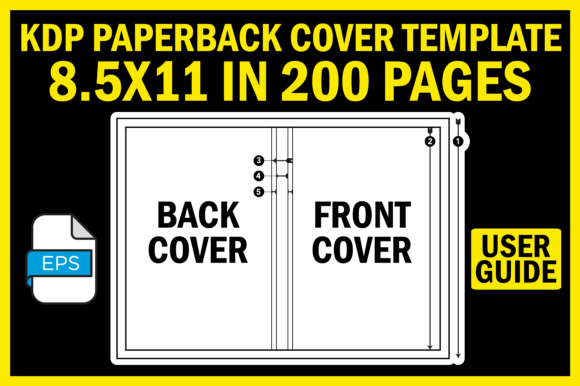
- CoverSizeGuide.jpg: Visual learners benefit immensely from this reference image. It breaks down every part of the cover, clearly labeling the bleed area, trim line, safe zone, and spine boundaries. Keeping this guide open while designing prevents accidental placement of critical elements too close to the edge.
- ReadMe.txt User Guide: This document offers straightforward instructions on file handling, layer management, and export settings, ensuring that even those new to print design can navigate the technical requirements confidently.
Creative Applications for Large Format Books
The 8.5x11 dimension is distinct from standard trade paperbacks. It commands attention and offers significant real estate for visual storytelling. Using the KDP Cover Template 8.5X11 in 200 Pages opens up specific creative avenues that smaller formats cannot accommodate.
Educational Textbooks and Workbooks
For educators and academic publishers, this size is ideal for instructional content. The expansive cover allows for clear hierarchy in titling and ample space for subtitles, edition numbers, and certification badges. Designers can utilize the extra width to create split compositions, placing a compelling visual on the right while keeping author credentials and publisher logos legible on the left. The 200-page spine provides enough width for readable vertical text, making the book easily identifiable on crowded shelves or in classroom stacks.
Art Books and Photography Portfolios
Visual artists require covers that act as a preview of the interior quality. The 300dpi EPS template supports full-bleed photography and intricate illustrations without compromising detail. Creators can experiment with edge-to-edge imagery, using the provided bleed guides to extend backgrounds safely beyond the trim line. For art books, minimalism often works best; the large format allows negative space to breathe, letting a single powerful image dominate the composition while maintaining professional spacing for metadata.
Business Guides and Professional Manuals
Entrepreneurs and consultants publishing comprehensive guides need covers that convey authority and clarity. The 8.5x11 format suggests substance and utility. Design approaches here should prioritize readability and structured layouts. Use the template’s safe zones to create grid-based designs that align title blocks, bullet points, and endorsement quotes systematically. A well-organized cover signals a well-organized book, building trust with potential readers looking for actionable advice.
Adapting the Template for Different Goals
Versatility is key when investing in design assets. While the dimensions are fixed, the application of the KDP Cover Template 8.5X11 in 200 Pages varies significantly based on user intent and audience expectations.
For Freelance Designers: This template serves as a reliable base for client projects. Instead of rebuilding specifications for every 200-page job, you can standardize your workflow. Create master files with preset color profiles and font styles, then duplicate them for new clients. This consistency reduces turnaround time and minimizes the risk of costly reprint errors due to sizing mistakes.
For Self-Publishing Authors: Budget constraints often mean handling design personally. This template bridges the gap between amateur and professional results. By adhering strictly to the CoverSizeGuide.jpg, indie authors can avoid common pitfalls like text getting cut off during trimming. It empowers creators to produce gallery-ready covers without hiring expensive prepress specialists.
For Marketers and Brands: Corporate publications, annual reports, or branded content journals often utilize this size. Marketing teams can adapt the template to match brand guidelines precisely. The EPS format allows for easy swapping of logos and color schemes while maintaining structural integrity across multiple publications in a series.
Maintaining Clarity and Organization in Design
Having the correct template is only the first step; executing a clean design requires discipline. Large formats expose flaws more readily than small ones, so organization is paramount.
- Respect the Safe Zone: Always keep vital text and logos within the designated safe area marked in the template. While background elements should extend to the bleed, critical content needs a buffer to account for mechanical shifts during printing.
- Layer Management: Keep the template guidelines on a locked layer separate from your artwork. Label layers clearly (e.g., "Background," "Typography," "Spine Text"). This prevents accidental movement of guide lines and streamlines the export process.
- Spine Calculation Verification: Although this template is pre-set for 200 pages, always double-check your final page count before exporting. Paper thickness can vary slightly by manufacturer; if your manuscript changes to 210 pages, the spine width will shift, requiring a new template.
- Contrast and Legibility: Test your cover at thumbnail size. The 8.5x11 format looks impressive full-screen, but most sales happen via small digital previews. Ensure your title remains readable when scaled down to one inch tall.
Practical Recommendations for Best Results
To get the most value from this resource, integrate it into a broader quality assurance process. Before finalizing any project using the KDP Cover Template 8.5X11 in 200 Pages, export a PDF proof and review it at 100% zoom. Check specifically where the spine meets the front and back covers; this transition area is where alignment issues most frequently occur.
Consider creating variations for different marketplaces or promotional uses. The EPS file can be adapted to create social media mockups, banner ads, or press kit materials. Because the source file is vector-based, you can resize elements proportionally for web use without losing sharpness. This multi-purpose utility extends the value of the template beyond just the print cover.
Finally, remember that tools facilitate creativity but do not replace it. Use the technical certainty this template provides as a springboard for bolder artistic choices. When you aren't worried about whether your book will be rejected for sizing errors, you are free to experiment with texture, color theory, and typographic hierarchy. Visit our store for more resources to continue building your library of professional-grade publishing assets, ensuring every project starts on solid ground.